Signs Your Brand Identity No Longer Fits Your Business
When to rebrand your business starts with a feeling, not a checklist: a quiet mismatch between who you've become and what your logo, site, and messaging still say on your behalf. Growth, pivots, ownership changes, and simple visual aging are the main reasons brands drift out of alignment with the businesses behind them. A refresh updates surface elements like color, type, and messaging while keeping your name and recognition intact; a full rebrand rebuilds positioning, voice, and visual system starting from scratch because the business underneath has fundamentally changed. Wrong-fit inquiries, price resistance, a Frankenstein mix of fonts and colors, and feeling disconnected from your own brand are concrete signs the gap has opened. Rebranding out of boredom, or using a new identity to paper over a weak offer or a website that doesn't convert, wastes money that a refresh or a fix elsewhere would have solved.
You open your website on a friend's laptop, the way a stranger would see it, and something in your chest tightens. The logo you loved three years ago now feels like a jacket you've grown out of, snug in the shoulders, short in the sleeves. Nothing is technically wrong. It just isn't you anymore. Knowing when to rebrand your business starts with that exact feeling, that quiet mismatch between who you've become and what your brand still says on your behalf.
This is a self-diagnosis guide, not a pep talk. Below you'll find why brands drift out of alignment, a scored checklist to gauge how far yours has drifted, the difference between a light refresh and a full rebrand, a plain-spoken look at what it costs and how long it takes, and the moments when the smartest move is to leave your brand alone. By the end you should know which camp you're in.
What Rebranding Really Means
Rebranding is the deliberate reshaping of how your business looks, sounds, and feels to the people you want to reach. That can be a tight adjustment or a ground-up rework, and the two live at opposite ends of a spectrum.
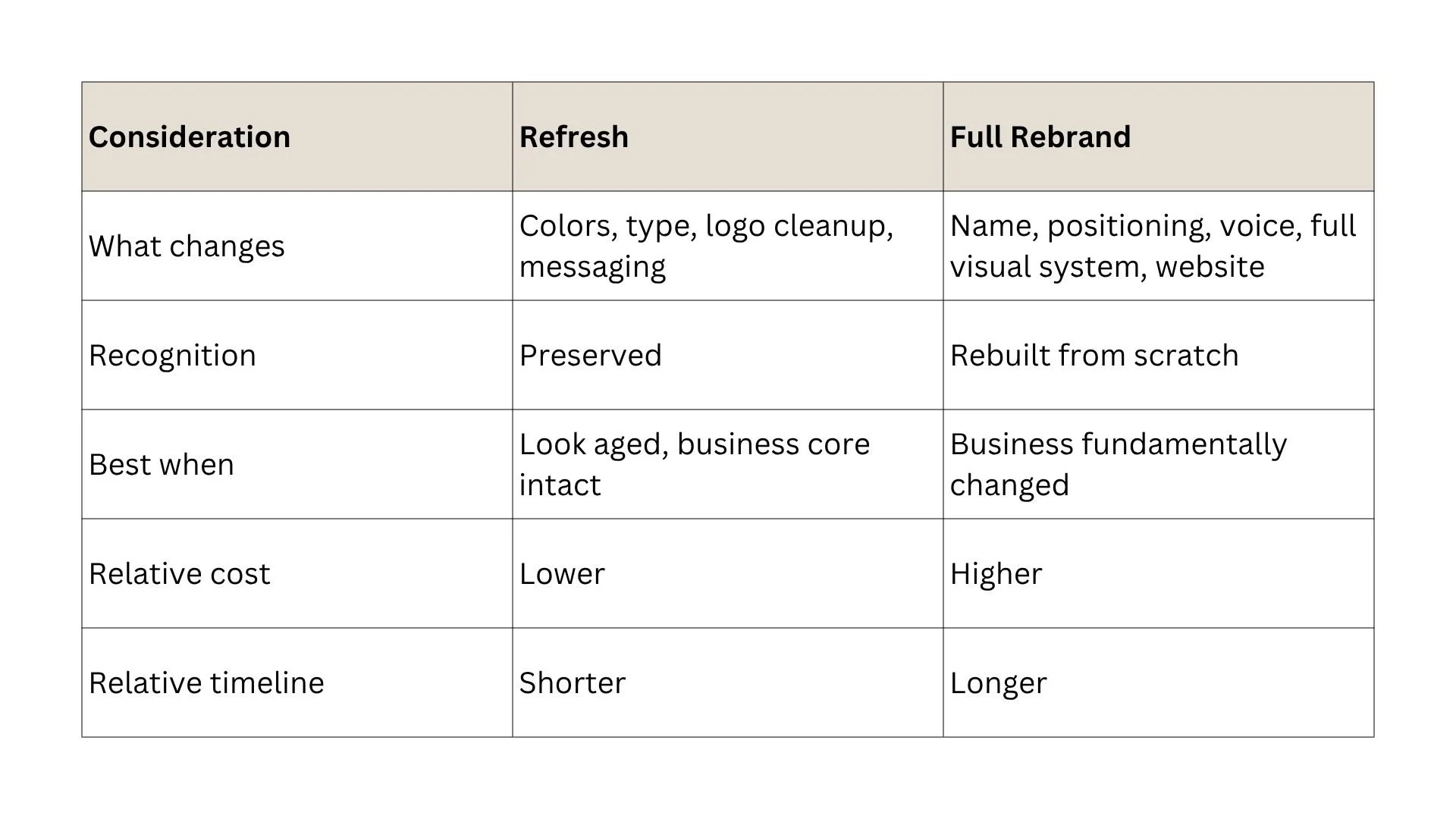
A partial rebrand, often called a refresh, keeps your core identity intact and updates the surface. New color palette, refined typography, a cleaner logo lockup, sharper messaging. Your audience still recognizes you the morning after. A total rebrand goes deeper, touching your name, your positioning, your voice, your visual system, and usually your website. It's the difference between repainting a room and moving to a new house. Most creative business owners need the first far more often than the second, and mistaking one for the other is where budgets and momentum get burned.
Understanding which end of that spectrum you're on matters, because it changes everything downstream: cost, timeline, risk, and how much of your hard-won recognition you're putting on the table. If your name and reputation are solid but your visuals feel dated, you're almost certainly in refresh territory.
Why Brands Drift Out of Alignment
Your brand was designed for the business you had when you made it. Businesses move. Brands, unless you tend to them, stay put. That gap is the drift, and it usually opens for a handful of predictable reasons.
The most common is simple growth. You started photographing backyard engagements and now you're shooting destination weddings in Positano. Your skill climbed, your prices climbed, your ideal client changed, and the sweet hand-lettered logo that suited the old you now undersells the new one. A brand built for a beginner will keep attracting beginner-budget inquiries long after you've outgrown them.
Then there's the pivot. You entered a new market, added a service, narrowed your niche, or dropped the work that drained you. If you rebranded a florist toward high-end editorial weddings but your Instagram still reads like a neighborhood flower stand, the disconnect does the filtering for you, and not in your favor. Ownership changes, a business partnership dissolving, a merger of two small studios, a shift from freelancer to agency, all crack the old identity in the same way.
Reputation is the quieter reason. Maybe an old association, an outdated name, or a season you'd rather leave behind is still stitched into your brand. And sometimes the drift is purely visual: trends aged your once-modern look into something that reads as "made around 2016." A logo is a moment in time. Give it enough years and it starts to date you.
When to Rebrand Your Business: 10 Signs It's Time
Here's a way to make the gut feeling measurable. Read each sign and score yourself 1 to 5, where 1 means "not at all true" and 5 means "painfully true." Add up the ten numbers at the end. It won't make the decision for you, but it turns a vague unease into something you can look at directly.
You wince when you send people to your website. If you find yourself apologizing for your own site before someone clicks, your brand is already working against you.
You're attracting the wrong-fit clients. The inquiries that land ask about your cheapest option or want something you no longer offer. Your brand is calling in the past.
You've raised your prices, but your brand still whispers "budget." Pricing power and perceived value are linked. A brand that looks entry-level makes premium rates feel like a stretch to the very people you're pitching.
You blend in with everyone in your niche. Line your homepage up next to three competitors and it's hard to tell who's who. A brand that fails to differentiate leaves you competing on price, which is the only fight nobody wins.
Your visuals no longer match your work. Your photography, your design, your craft has grown more refined than the identity wrapped around it. The wrapping is now the weakest link in the chain.
Your messaging describes a business you no longer run. Your about page, taglines, and service descriptions still talk about who you were two years ago.
You've cobbled together a Frankenstein look. Over time you've added fonts, colors, and graphics piecemeal until nothing quite matches. Your Instagram, website, and PDFs feel like three different companies.
You've changed your name, offer, or focus. A structural change to the business almost always needs the brand to catch up.
You're embarrassed to reach the audience you really want. If landing your dream client would mean they'd see the current brand, and that thought makes you hesitate, that hesitation is data.
You feel disconnected from your own brand. You don't reach for your brand colors. You avoid your logo. It stopped feeling like home. That internal signal is as valid as any market one.
Now the tally. A score under 20 usually means your foundation is sound and a light touch will do. Somewhere in the 20 to 35 range points toward a focused refresh, likely visuals and messaging rather than a full teardown. Above 35, and especially if the name or offer itself has changed, you're looking at a full rebrand. Treat the number as a compass, not a verdict.
The Internal Signs Most Guides Skip
Most rebranding advice fixates on how the outside world sees you. The earliest cracks, though, show up inside the business, often long before a client ever notices.
Watch how you talk about yourself. If you can't describe your business the same way twice, if the words come out differently on a discovery call than they do on your website, your brand messaging has stopped guiding you without you noticing. For solo business owners this shows up as decision fatigue: every new Instagram post, every proposal, every email signature becomes a small "what should this look like" negotiation because there's no clear system to fall back on. A brand that's working makes those choices for you. A brand that's drifted makes you reinvent the wheel daily, and that friction is a cost you pay in energy you can't get back.
If you've grown past yourself and now have a team or contractors, the tell is inconsistency. Assets used wrong, colors slightly off, three versions of the logo floating around. That's rarely carelessness. It's usually a sign the brand system isn't clear or documented enough to hold up under more than one pair of hands. Naming that early saves you from a full rebrand later. This is exactly why a defined brand foundation matters more than a pretty logo, a point worth sitting with if you've been treating branding as decoration rather than infrastructure. Our take on what a brand really includes beyond the mark itself pulls that apart.
Refresh or Full Rebrand: Choosing the Right Scope
Getting the scope right saves you the two most expensive mistakes: over-rebranding when a refresh would do, and refreshing when the problem runs too deep for surface work.
Reach for a refresh when your name, your positioning, and your reputation still hold, and the issue is that the look has aged or the pieces have stopped matching. New palette, updated type, a modernized logo, tightened messaging, maybe a website reskin. You keep your recognition and your search equity, and you spend less. If your score landed in the low-to-mid range, this is almost always your answer.
Go for a full rebrand when the business underneath the brand has fundamentally changed. A new name. A new audience with different values. A merger. A pivot so complete that the old identity actively misrepresents you. Here you rebuild from strategy up: positioning, voice, visual system, and website together, because patching one part onto a mismatched whole just moves the seam somewhere else. If you're weighing which route fits, the comparison between a fast, focused branding sprint and a full custom identity is laid out in our look at how a brand intensive differs from a ground-up identity project.
What a Rebrand Costs and How Long It Takes
Nobody in the top search results will give you a straight answer on this, so here's a candid one, with the caveat that real numbers depend entirely on scope, who you hire, and what you already have in place.
Cost sits on a wide spectrum. DIY, using a Canva-based branding kit and doing the work yourself, is the lowest outlay in dollars and the highest in hours. A semi-custom route, where you buy a designed brand kit or template and adapt it, sits in the middle. A fully custom rebrand from a designer or studio is the highest investment and the one that produces a system built only for you. There's no single right tier. There's the right tier for where your business is and what your time is worth. If you want to see how those choices shake out in practice, the way DIY and hiring a professional really compare maps cleanly onto branding too.
Timeline is easier to pin down by scope. A focused logo or refresh project can run in the range of one to two weeks when it's tightly defined, which is roughly the shape of our one-to-two-week brand intensive. A full custom brand identity, with strategy, exploration, and revisions, more commonly stretches across several weeks. Add a website rebuild on top and you're often looking at three to six weeks or more for the site alone. Build in breathing room. A rebrand rushed to hit an arbitrary launch date tends to produce something you'll want to redo again sooner.
When You Shouldn't Rebrand
Sometimes the best branding decision is to leave your brand exactly where it is. Rebranding out of boredom is real, and it's expensive. If you're simply tired of looking at your own logo but your audience still recognizes it, your clients still connect with it, and it still fits the business you run, that's restlessness, not misalignment. Give it a season before you spend.
Hold off, too, if the real problem isn't your brand at all. Slow inquiries can come from pricing, positioning, a weak offer, or a website that doesn't convert, and none of those are fixed by a new color palette. A gorgeous rebrand bolted onto a broken sales page just makes the disappointment prettier. If your visuals are fine but the site underneath them leaks visitors, start there instead; the common website mistakes that cost you clients without you realizing it are cheaper to fix than a whole identity.
And avoid rebranding mid-launch or during your busiest stretch. Changing your identity while running a major promotion or in peak season splits your focus and confuses your audience right when you need consistency most. The right time is when you have the room to do it properly, not when you're already stretched thin.
-
There's no fixed schedule, and chasing one is a trap. Deciding when to rebrand your business should be driven by change, not the calendar. A light refresh every handful of years to keep visuals current is reasonable, while a full rebrand should be reserved for genuine shifts in your name, audience, or offer. Rebranding too often erodes the recognition you're working to build.
-
A partial rebrand, or refresh, updates surface elements like color, type, and messaging while keeping your name and core identity intact, so your audience still recognizes you. A total rebrand rebuilds from strategy up, often including a new name, positioning, voice, and website. Refreshes preserve equity and cost less; total rebrands are for businesses that have fundamentally changed.
-
Not automatically, but check whether your brand supports the new price. If your visuals and messaging read as entry-level while your rates say premium, that gap makes higher prices harder to sell. Often a focused refresh of visuals and copy is enough to close it without a full teardown.
Sitting with that scored checklist and still unsure which way to go?
That's normal, and it's the exact spot where an outside eye earns its keep. If your business has clearly outgrown its current look and you're ready to close the gap, a focused brand intensive gives you a designed identity in one to two weeks, and if you'd rather start by understanding what your brand actually stands for first, the brand clarity workbook is a calmer, lower-cost first step. Either way, the clear signal to act on is that persistent feeling that your brand no longer fits, because that feeling is almost always right about when to rebrand your business.

A digital download PDF Workbook
Build a Brand Rooted in Purpose and Connection - a Brand that Feels Like You.
75+ Pages of Guided Exercises & Examples for Creatives Ready to Elevate Their Business
➜ Get clear on your Business Purpose
➜ Become besties with your Dream Clients
➜ Define a Brand Personality that feels true to who you are
➜ Fine-tune your Brand Voice
➜ Build the clarity and confidence to grow your business into a brand that’s genuine, memorable, and unmistakably you