How to Budget for a Brand and Website Launch as a Solo Business Owner
How to Budget for Branding, Website Design and Content as a Small Business
Planning a new brand and website is exciting, but figuring out how much to spend on everything can get overwhelming very quickly.
How much should you spend on branding? Is a custom website worth the investment? Should you hire a photographer before or after your website is designed? And how much of your budget should you save for marketing?
There isn't one perfect number that works for every business. But there is one thing I believe strongly: your website and your content deserve equal consideration in your budget.
Your website can be beautifully designed, but if it's filled with rushed copy, inconsistent photos or placeholder images, it won't have nearly the same impact. At the same time, you can invest in incredible brand photography and thoughtful copy, but those things still need a strategic website to bring everything together.
Instead of putting the majority of your budget into one area, think about your brand, website and content as three parts of the same experience.
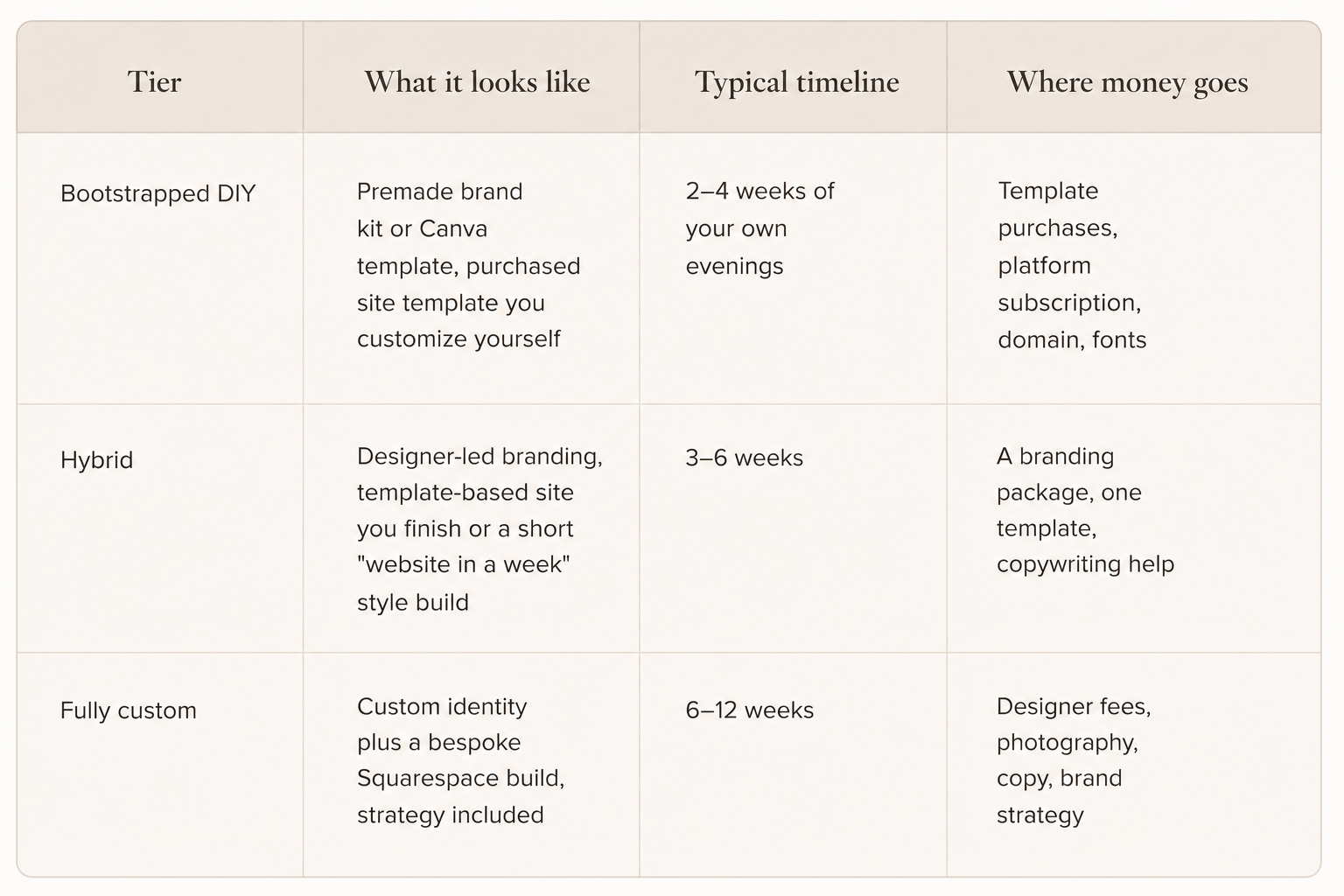
Choose your tier first because it sets timeline, labor, and support downstream
Nothing else works until you know which lane you're in. Solo owners generally land in one of three, and the tier decides everything downstream: timeline, who does the work, how much handholding you get.
How much should you budget for branding and website design?
The amount you need will depend on where your business is right now.
A new business might start with a semi-custom brand and a premium Squarespace template. An established business going through a rebrand might invest in strategy, custom branding, professional photography, copywriting and a completely custom website.
Rather than starting with a specific dollar amount, I recommend deciding on the total amount you're comfortable investing and then looking at everything your launch actually needs.
Your budget will usually need to cover branding, website design, website content, photography, copywriting, platform fees, your domain and some form of marketing after launch.
The mistake is thinking of photography and copy as optional extras.
They are part of the website.
Your website is only as strong as the content inside it
I see content get pushed to the bottom of the budget far too often.
A business invests in professional branding and a beautiful custom website, then reaches the content stage and realizes there isn't enough money left for professional photography or copywriting.
Suddenly the beautiful website is being filled with old images, inconsistent stock photography and copy written the night before launch.
Good design can organize your content and present it beautifully, but it can't replace it.
Your photography creates the feeling of your brand. Your copy explains what you do, who you help and why someone should choose you. Your portfolio gives potential clients proof of your work. Testimonials build trust.
The website creates the space for all of those things to work together.
This is why I would rather see a business invest a little less in the website itself and leave enough room for strong content than spend the entire budget on the website build.
How should you divide your brand and website budget?
There is no percentage split that will work for every business, and I don't think there needs to be.
Instead, look at what you already have.
If you're a wedding photographer with years of beautiful portfolio images, you might not need to invest heavily in new photography. Your budget could go further toward your brand and website.
If you're a coach, designer or service provider who has never had professional brand photos taken, photography might deserve just as much attention as your website.
If you're launching a product-based business, photography may be one of your biggest investments because your customers can't physically see or touch the product before buying.
The goal isn't to make every category exactly equal. The goal is to avoid spending so much in one area that the rest of your brand experience suffers.
In the original budget example, branding and website design each received 35% while content received only 10%. I would approach this more flexibly, especially for visual and service-based businesses where photography, portfolio imagery and copy play such a large role in whether a website actually converts.
Should you invest in branding or a website first?
Ideally, your branding should come before your website.
Your brand gives the website its visual direction. Your colors, typography, logo system and overall creative direction influence almost every design decision that comes afterward.
That doesn't mean you need an enormous branding package before you're allowed to build a website.
For a newer business, a focused brand identity with a primary logo, secondary logo, color palette, typography and clear visual direction can be more than enough.
You can always expand your brand later with custom illustrations, patterns, packaging, collateral and more detailed guidelines.
What matters is having a strong enough foundation that your website doesn't feel like a collection of unrelated design choices.
How much should you spend on a website?
Website costs can vary enormously because you're not just paying for a collection of pages.
You're paying for the thinking behind those pages.
A well-designed website considers how someone moves through your site, where they find important information, how your services are presented, how your portfolio is organized and how visitors eventually reach your inquiry form, shop or booking page.
You also need to account for the less exciting website expenses, including your platform subscription, domain, font licenses and any additional software or integrations your business needs.
For many small businesses, a premium Squarespace template can be a great place to start.
You're getting a professionally designed foundation without the investment of a completely custom website. You can then put more of your available budget toward professional photography, copywriting or other areas that will make the template feel completely your own.
A custom website makes more sense when your business is established, your offers are clear and you need something specifically built around your customer journey, services and goals.
Don't wait until the website is being designed to think about content
Your website content should ideally be planned before the website design process begins.
This doesn't mean every sentence has to be absolutely perfect before your designer starts. But you should have a good understanding of what needs to go on each page and what imagery will support it.
Your homepage might need a strong hero image, a short introduction, featured services, portfolio work, testimonials and a clear call to action.
Your About page needs more than a headshot.
Your Services page needs enough information for someone to understand what you're offering and decide whether it's right for them.
When photography and copywriting happen alongside the website process, the design can actually be built around your real content rather than forcing your content into a layout afterward. The original budgeting plan also recommends running photography and copywriting alongside the website build rather than leaving them until the end.
What should you spend less on when your budget is limited?
A smaller budget doesn't mean your brand or website has to look unprofessional.
It usually means you need to simplify.
Instead of launching with twelve pages, launch with five really good ones. Instead of commissioning custom illustrations, focus on photography. Instead of building an elaborate custom website, start with a professionally designed template. Instead of creating every possible piece of brand collateral, invest in the pieces you're actually going to use.
I would cut decorative extras long before cutting the fundamentals.
Strong photography, thoughtful copy, a cohesive visual identity and a website that works beautifully on both desktop and mobile will have a much bigger impact than complicated animations or an enormous brand guidelines document.
This is also why a smaller, well-planned budget can sometimes produce a stronger result than a much larger one. The original article makes a similar point: how the budget is allocated can matter more than the total amount available.
Don't forget about your budget after your website launches
Your website launch shouldn't use every last dollar you've set aside for your online presence.
Once the site is live, you still need people to find it.
That might mean creating Pinterest content, writing blog posts, improving your SEO, building your email list, sharing your launch on social media or investing in paid advertising.
You'll also have ongoing expenses such as your website subscription, domain renewal, email marketing software, scheduling tools and occasional website updates.
Your photography and content will evolve too.
You don't necessarily need a new brand photoshoot every three months, but your business shouldn't still be relying on the exact same images five years later.
Your website should grow alongside your business.
So, what is a realistic budget for a brand and website launch?
A realistic budget is one that allows you to create a complete experience rather than one impressive piece.
If you have $3,000 available, don't automatically spend $2,800 on a website and leave yourself $200 for everything else.
If you have $10,000 available, you still don't need to spend it all on custom design simply because you can.
Look at what your business actually needs right now.
Maybe that's professional branding paired with a Squarespace template and a beautiful brand photoshoot.
Maybe you already have an established visual identity and your money would be better spent on a custom website and copywriter.
Maybe your website is already strong, but your photography no longer represents the level your business has reached.
The right budget is going to look different for every business.
Is professional website design worth the investment?
Professional website design can absolutely be worth the investment, particularly when your website plays a major role in bringing in leads, bookings or sales. But design isn't working alone. A website converts because the design, messaging, photography, offer and user experience support each other. That's why I don't believe content should be treated as the tiny final piece of a website budget. Your website is the structure. Your content is the story you're putting inside it. You need both.
When you're planning your next brand or website launch, think about the full experience your potential client will have when they land on your site.
What will they see?
What will they read?
Will they immediately understand what you do?
Will your photography make them want to keep scrolling?
Will your website make it easy to take the next step?
Those are ultimately much more important questions than finding the perfect percentage to put into a spreadsheet.
A beautiful online presence isn't created by one expensive piece. It's created when your branding, website, photography and messaging feel like they were always meant to belong together.